



Returning to Pole After a Break: How to Start Again Without Rushing
Coming back to pole after a few weeks or months can feel familiar in some ways and surprisingly different in others. You may remember exactly what a move is supposed to look like while your grip, timing or confidence feels different.
There is no single timeline for returning to pole. Use the first sessions to find out what feels familiar and what needs more practice. Your current ability is a starting point, not a judgment on your earlier training.
Start from where you are today, not where you stopped
Your last pre-break level is a poor test for your first day back. Instead of asking, “Can I still do everything I could before?”, ask, “What feels controlled today?”
If you are returning to a studio, tell the instructor that you have had time away and roughly what you were training before the break. That gives them useful context when they offer easier variations, next steps or hands-on assistance. If the studio has a fundamentals, refresher or lower-level class that matches your current confidence, using it is not “going backwards”; it is simply a practical way to re-establish your baseline.
Rebuild familiar foundations before testing advanced moves
Save your hardest old trick for a later session, when your instructor agrees that you are ready. Start with the foundations your studio normally uses: controlled spins and transitions, basic holds, climbs or climb preparation, sits, conditioning and familiar shapes that you can perform with good technique.
The exact list will depend on your level and your studio. The principle is more important than the move list: begin with movements you understand well enough to notice whether your grip, positioning and control are actually there.
Manufacturer safety guidance from X-POLE also advises dancers not to attempt moves beyond their ability without an instructor. After a break, “ability” means what you can control now, not what was once on your checklist.
Expect grip to feel different — and diagnose it before blaming strength
Grip is not just hand strength. Pole grip depends on contact, friction, body position, technique and the particular pole surface, and it can also be affected by sweat or products on the skin. That is why a returner can feel strong in general and still feel surprisingly slippery in the first session back.
Before assuming you have lost all your strength, check the simple things: are the correct contact points exposed, are your hands and skin free from lotion or oil, is your position the same as the one your instructor is cueing, and does the pole need wiping according to the studio’s rules?
If grip is the main thing that feels unfamiliar, our beginner guide to pole grip explains skin contact, sweat, pole finish and grip aids in more detail.
Your skin may need time to get used to pole contact again
Returners often talk about pole pressure and skin sensitivity feeling more noticeable after time away. That experience is not identical for everyone, and it does not need a fixed schedule. If a familiar hold suddenly feels much more intense on the skin, reduce the difficulty, spend less time in the position and let your instructor help you choose an appropriate variation.
Trying to prove that you can tolerate exactly what you tolerated before the break is not useful training. Control comes first.
Wear something familiar and reliable
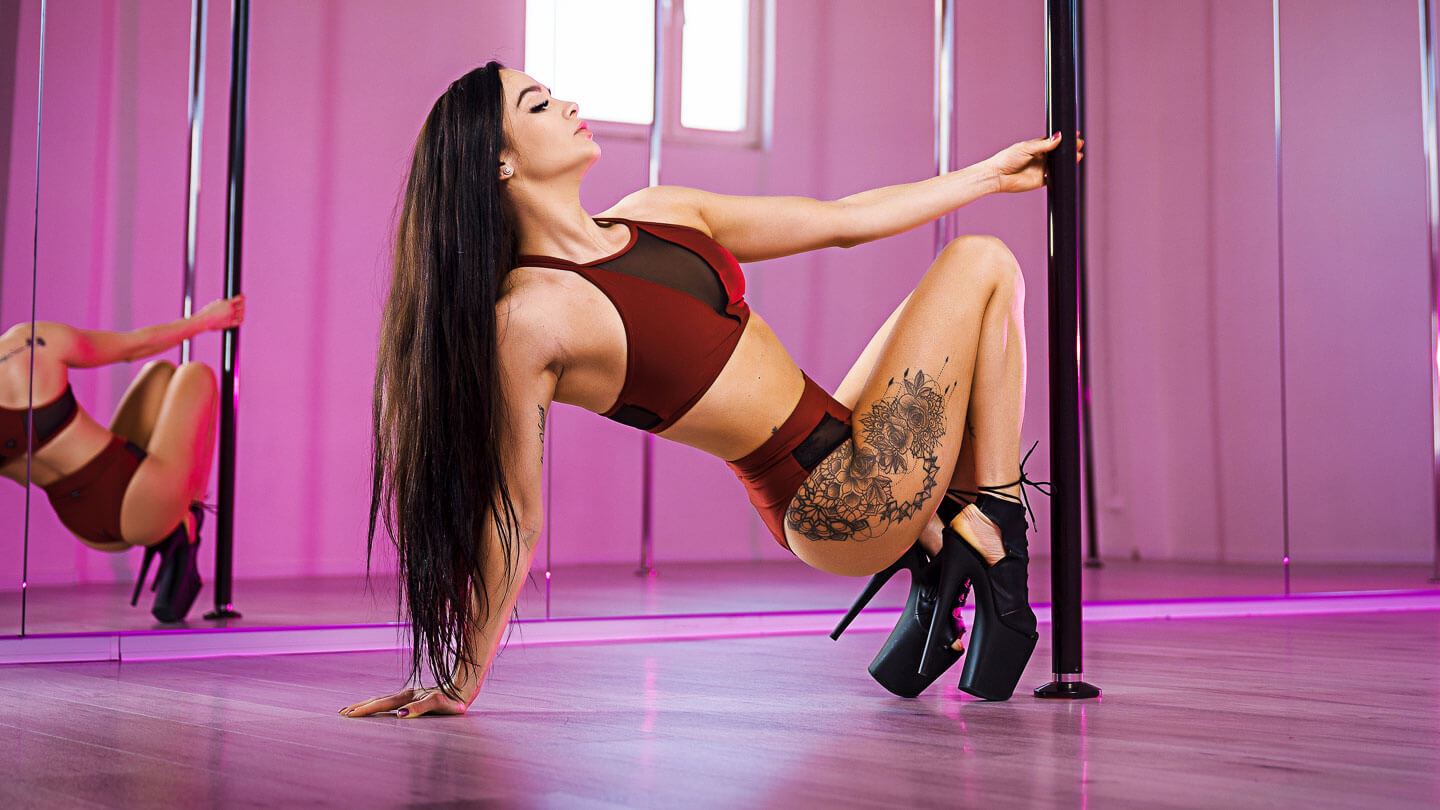
Your first sessions back are not the moment to troubleshoot an outfit that rolls, shifts or covers a grip point you need. Choose polewear you already trust: a secure top and fitted shorts that stay in place through the movements you plan to train.
You do not need the smallest possible shorts for every session. You only need the skin exposure required for the contact points in your current class. For a refresher on the practical basics, see what to wear to a pole class and our guide to choosing pole dance shorts.
If your old kit no longer fits comfortably, take a look at Mandy mid-rise shorts and the Nicole sports bra with medium support. Use the size charts and a simple movement check to choose each piece. There is no need to replace clothing that still works well.
One rule is worth repeating: avoid body oils and lotions before pole. They can transfer to the pole and reduce friction.
Do not turn the first week back into a catch-up project
It is tempting to make a list of everything you “should” get back immediately: a climb, an invert, a favourite combination, a certain number of classes. That turns a useful return into a comparison with an old version of your training.
A better first goal is simpler: leave the session knowing what currently feels solid, what needs rebuilding and what you want your instructor to help you with next. That gives you a real baseline instead of a pass/fail test.
If the break followed an injury or health issue
A general pole guide cannot tell you when it is medically appropriate to return after an injury, surgery, pregnancy or another health-related break. Follow the advice of the clinician responsible for your care, and tell your instructor about any relevant restrictions before training.
Once you are cleared to return, the same principle still applies: work from your current capacity and use appropriate progressions rather than assuming your previous level is immediately available.
A simple checklist for your first session back
- Choose a class that matches your current confidence, not only your old level.
- Tell the instructor that you are returning after a break.
- Start with familiar foundations before harder tricks.
- Check technique, contact points and skin products if grip feels off.
- Wear polewear you trust and avoid lotion or oil before class.
- Finish with a clear idea of what feels solid and what needs rebuilding.
FAQ
Should I go back to a beginner class after a long break?
Not automatically. It depends on how long you were away, what you trained before and what you can currently do with control. A fundamentals or refresher class can be useful, but an instructor who knows the class structure is best placed to suggest the right level.
Why does my grip feel worse after a break?
There can be several reasons. Grip depends on technique and contact as well as strength, and sweat, lotion, pole finish and skin condition can change how secure a move feels. Check those variables before reducing the problem to “weak hands”.
How quickly should I get my old tricks back?
There is no reliable universal timeframe. Use controlled movement as the benchmark and let difficulty increase as your technique and confidence return.
Do I need new polewear when I come back?
No. If your existing kit still fits well, stays in place and exposes the grip points you need, familiar polewear may actually make the return simpler.


Leave a comment