



How to Choose Pole Dance Shorts: Coverage, Rise, Grip and Fit
A good pair of pole dance shorts should leave the skin you need for grip uncovered, give you the coverage you want and feel comfortable through your movements. The shortest pair is not automatically the right one. Start with your training and your proportions, then choose the colours and details you enjoy.
Four questions help narrow the choice: where do you need skin contact, how much back coverage do you like, where should the waistband sit, and does the cut stay comfortable when you move?
Start with the skin contact your training needs
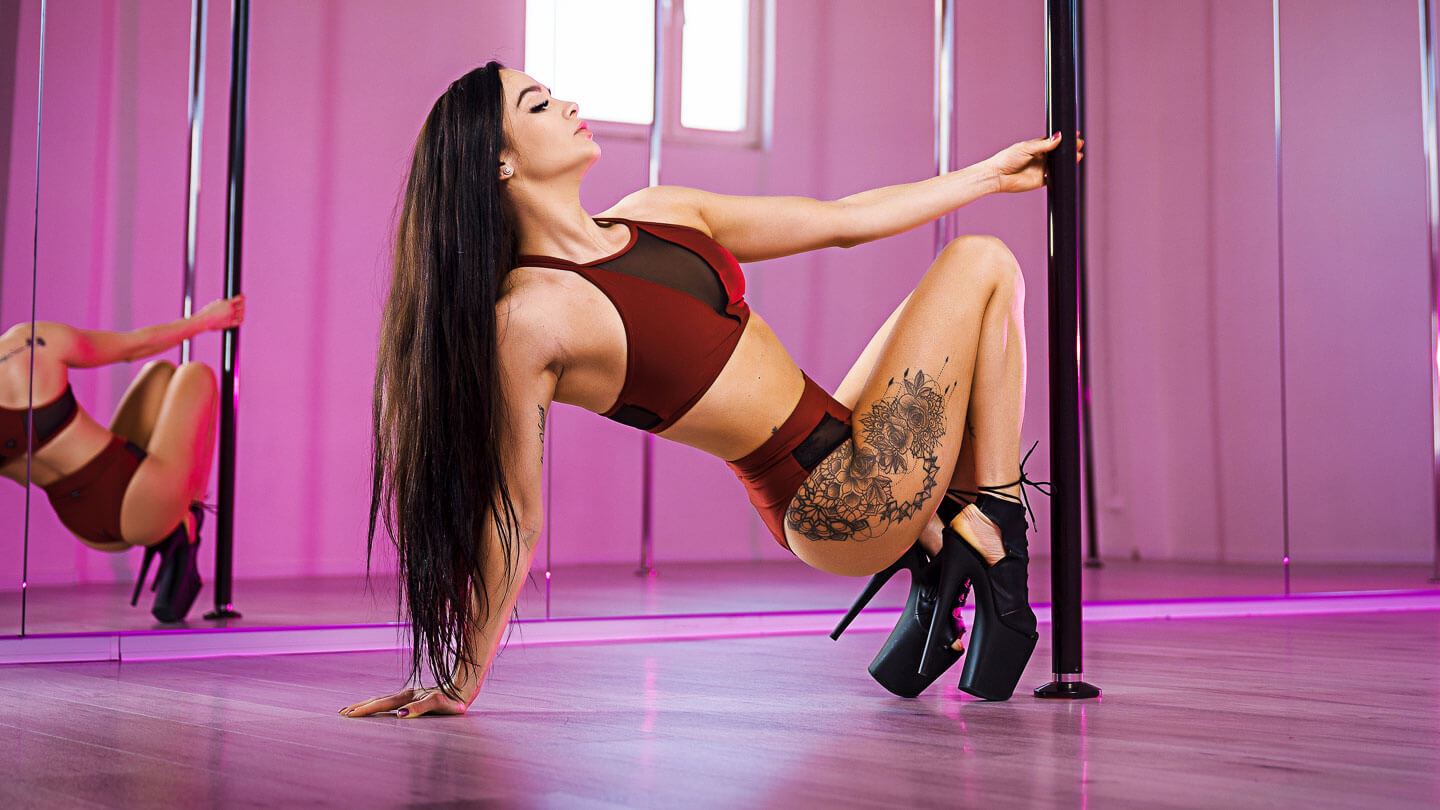
Many pole holds rely on direct contact between your skin and the pole. Depending on the movement, that may involve the upper inner thighs, knee crease, hips or side of the torso. Ordinary fabric can get between those surfaces, which is why fitted shorts are practical for many technique classes.
Ask your instructor which contact points the session uses. You can keep more of your body covered where skin contact is not needed. A high waistband may work well for one routine and cover a useful contact point in another.
Our guide to pole grip explains the role of skin, technique and the pole surface. If you are getting ready for lesson one, see what to wear to your first pole class.
Choose back coverage separately from waistband height
Back coverage describes how much of the bum the shorts cover. You may see the terms full, classic and cheeky: broadly, fuller coverage, a middle ground and a more revealing back cut. These labels are not standard measurements, so compare the rear photographs.
A high waist can have a cheeky back; a mid-rise pair can cover more of the bum. Neither tells you your level as a dancer. Choose the back cut you enjoy wearing.
Back coverage is also different from coverage at the front and crotch. Check both when you squat, lift a knee and open your legs within a comfortable range. A more revealing back should not mean a front panel that pulls away from where you want it.
For a closer look at back cuts, compare full, classic, cheeky and adjustable styles in our pole shorts coverage guide.
Low, mid or high rise?
- Low-rise: less fabric around the stomach and waist. Mia is an option if you like this lower position.
- Mid-rise: a waistband between the hips and high waist. Mandy and Hot Pants share this category but have different back coverage.
- High-waisted: more stomach coverage. Betty, Lola, Monica and Emma offer different high-waisted designs.
Your torso length affects where the top edge lands. Try sitting, bending and reaching to see whether it stays comfortable or presses under the ribs. A short torso does not rule out a high waist, but comparing more than one rise can be useful.
See our comparison of high-, mid- and low-rise pole shorts for more detail.
Compare the Dragonfly cuts
| Model | Waist | What to compare |
|---|---|---|
| Mandy | Mid-rise | A classic back cut with more coverage than Hot Pants; no centre-front seam. |
| Hot Pants | Mid-rise | A cheekier back cut and no centre-front seam. |
| Mia | Low-rise | A lower waistband with a cheeky back and no centre-front seam. |
| Betty | High-waisted | A higher waistband with a back cut between classic and cheeky; no centre-front seam. |
| Lola | High-waisted | A cheeky back with a scrunch detail; no centre-front seam. |
| Monica | High-waisted | A cheeky cut with mesh details and no centre-front seam. |
| Emma | High-waisted | Side drawstrings for adjusting leg length and side coverage; a centre-front seam. |
The drawstrings on Emma let you change how much of the thigh is exposed while keeping a high-waisted construction. Lola has no side drawstrings: wearing it higher or lower changes the appearance of its back coverage. Betty is a separate high-waisted cut, without Lola’s scrunch detail.
Check lining, seams and leg openings
Dragonfly shorts have a lined crotch, with the exception of Celine and Zoe, which use leggings-style construction. Our leggings do not have this crotch lining either. The lining adds a layer through the crotch; fit still determines whether that area stays centred in movement.
A centre-front seam is a matter of preference, not a sign that a short is better or worse. Notice where seams sit on your body and how the front feels in a squat. Also check whether the leg openings press into your thighs or loosen away from the body.
Mandy, Betty and Hot Pants have no separate tight elastic bands at the waist or legs. If firm edges bother you, that is a useful feature to compare alongside the overall size.
Use your measurements, then refine the cut
Measure your hips around the fullest part of the hips and bum with the tape level. Measure your waist too, then compare the Dragonfly size charts and the notes for your chosen product. If you fall between sizes or different measurements point to different sizes, ask for advice with the model name and your measurements.
Do not automatically size down to close a waist gap. You could create pressure at the hips, thighs or crotch. Our guide to shorts for a small waist, wider hips and strong thighs explains how to compare those proportions.
Try movement before you decide
Within the return conditions, try a comfortable squat, knee lift, overhead reach and wide stance. Check the front, sides and back afterwards. Does the waistband roll, does the crotch shift, or do you instinctively pull the legs back into place?
A problem across the whole garment may point towards size; a problem in one area can mean that a different cut would suit you better. You do not need to attempt a new trick or inversion to make this first check.
Choose fabric and details for the session
Dragonfly uses Italian performance fabrics with LYCRA® fibre for stretch and shape retention. The materials are OEKO-TEX certified. Compare the feel of the exact fabric version: velvet, mesh and lace introduce different textures and design details.
For floorwork, notice where seams or decorations press against the floor. For a performance, rehearse in the full outfit and check it under suitable lighting. For a competition, read the current rules for your event and category before choosing the cut.
A few questions before buying
Do beginners need specialist pole shorts immediately?
Not necessarily. Suitable fitted shorts can work for an introductory class if they leave the required contact points free. Check the studio’s guidance, then use your first lessons to learn which cuts you prefer.
Should pole shorts feel tight?
They should fit close without painful pressure or restricted movement. More tension does not guarantee that the shorts will stay in place.
Can you wear underwear underneath?
That is a personal choice. If you do, check that it stays covered and comfortable in movement without adding seams that bother you. Follow the return conditions when trying on new shorts.
Explore the Dragonfly pole shorts collection with your preferred rise, back coverage and movements in mind. Choose the details that let you enjoy wearing the shorts through the whole session.


Leave a comment